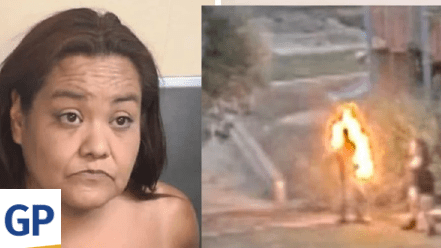
Deerfield Beach, FL – Authorities are offering a reward for information about the arsonist who set a Broward Sheriff’s Office (BSO) patrol vehicle on fire with a deputy inside it on Sunday.
The incident occurred at about 1:30 a.m. on July 3 in the 1000-block of West Hillsboro Boulevard in Deerfield Beach, WPLG reported.
BSO said the deputy noticed heavy smoke coming from the rear passenger side of the vehicle.
About the same time, “a passerby also flagged the deputy down and advised him that his rear passenger tire was on fire,” WPLG reported.
BSO said the deputy jumped out of his vehicle to investigate the smoke and immediately saw a lit flare that had been placed under his vehicle, according to the press release.
Two men — one in Queens and one in Brooklyn — died after being shot by police Saturday evening, the NYPD said.
Police said the first incident occurred just after 6 p.m. at 205-17 116th Ave. in St. Albans.
According to NYPD Chief of Patrol Jeffrey Maddrey, a man who identified himself by name called 911 twice and made threats to multiple officials, including the governor and members of the police department.
Maddrey said members of the 113th Precinct listened in on the second call and responded with multiple units. According to Maddrey, when officers walked toward the house, a man emerged from the house, and confirmed his identity when one of the officers called him by name.
The man then immediately started cursing at the officers and refused to comply with commands from officers, Maddrey said. According to Maddrey, after a short verbal exchange, the man pulled out a gun and fired it at officers.
At least six officers returned fire, and the man was struck, according to Maddrey.
Maddrey said officers attempted life-saving measures on the man who was shot at the scene. However, the man ultimately died of his wounds at the hospital, according to Maddrey.
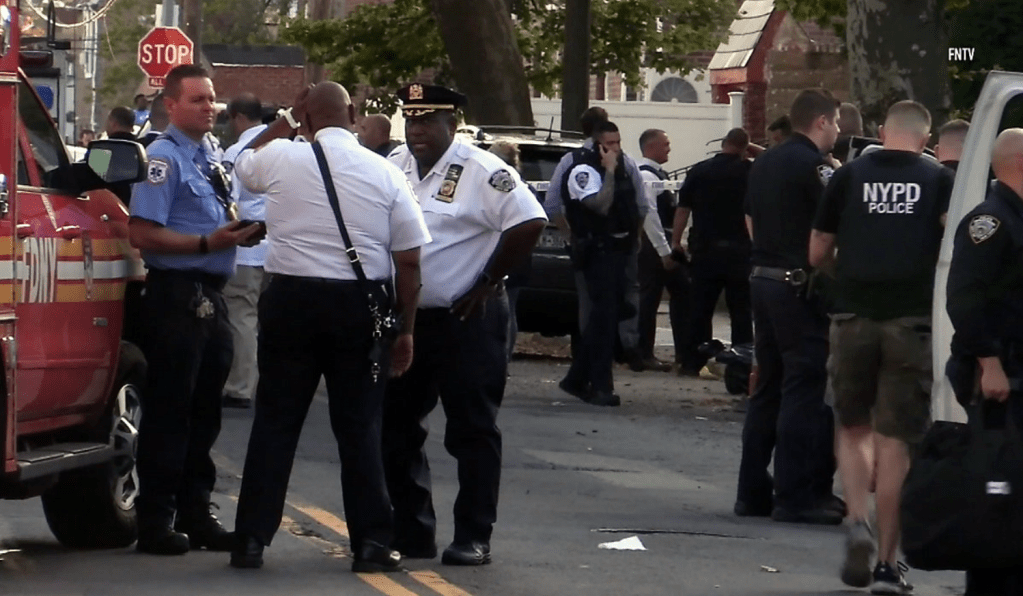
The FDNY said a total of 10 officers were also injured at the shooting. Nine officers were transfered to Northshore Community Hospital with non-life threatening injuries, while one refused medical attention. Maddrey said they were treated for conditions like tinnitus, trauma and high blood pressure.
According to Maddrey, about an hour and a half later, at around 7:30 p.m. in Downtown Brooklyn, officers withthe 88th Precinct’s public safety team stopped a gold Nissan that they observed committing traffic violations while traveling down Flatbush Avenue.
At some point, the officers asked the occupants of the vehicle to step out of the car, Maddrey said. At that point, according to Maddrey, the man in the front passenger side of the car left the vehicle and started running.
One of the officers from the 88th Precinct public safety team pursued the man on foot for a short time, Maddrey said. According to Maddrey, that pursuit stopped in the vicinity of Rockwell Place and Lafayette Avenue, when the man who fled the car pulled out a gun and started firing at the officer. The officer fired back and struck the man in the chest, Maddrey said.
The man who was shot in this incident later died of his injuries at a local hospital, according to Maddrey. Maddrey said the officer that chased him was treated for tinnitus and other injuries.
Guns were recovered at the scene of both shooting incidents, according to the NYPD, who provided photos on social media.
So this thug, fleeing a cop, failing to comply, reaching into his pockets (could have been a gun,right?) to throw drugs away, fighting with the cop for the taser he correctly tried to use AND HIS GUN, gets killed and the officer is suspended? In the height of battle the officer had his gun in one hand and the taser in the other. He accidently fired both at the same time. An accident caused by this thug who chose to fight and resist. Remember one thing. When an unarmed perp decides to fight a police office, he is as good as armed because if the cop loses control of his gun he is dead. I hope this officer is not railroaded.
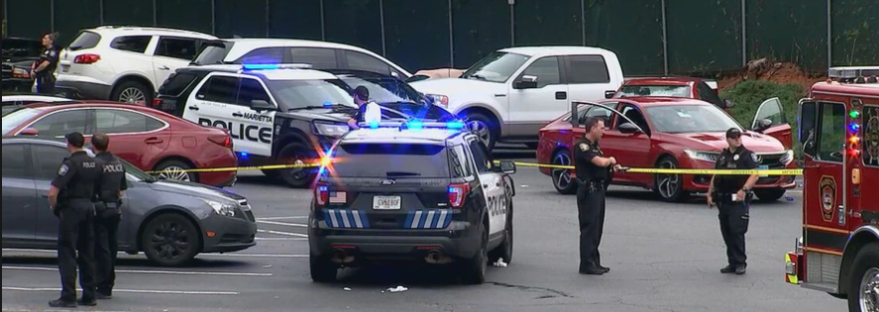
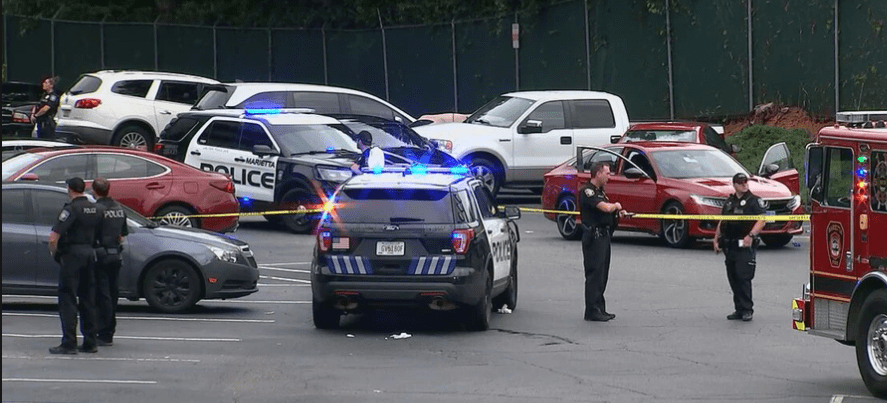
Marietta police fatally shot a driver accused of pinning an officer between two vehicles and dragging the officer through the parking lot of a motel Thursday night, officials said.
More than 30 people lost their lives from gun violence around the country over a blood-spattered Memorial Day weekend — just days after the tragic school shooting in Uvalde, Texas.
Dozens of victims — including 13 in Philadelphia alone — lost their lives with violence spiraling across the nation.
Engaging the shooter is ESTABLISHED PROTOCOL and every law enforcement agency in America is aware of it.
Unarmed teachers rush into harms way to aid children, we must expect the same from our officers first at the scene. The Uvalde officers stopped engaging the shooter and did not re-enter- even when their numbers increased at the scene. Did their department train them correctly and equip them adequately for this type of incident?
No further study is necessary. No further analysis is needed.
This was the same terrible outcome as other non-engaged shooter incidents. We know what happens when law enforcement fails to engage- we have too many deadly examples.
The Texas incident is virtually identical to the Columbine HS response, where law enforcement formed a perimeter outside waiting for the arrival of SWAT as kids were hunted down and slaughtered.
The difference is that there wasn’t an effective plan in place at the time of Columbine. This department should have been well aware of the established protocol.
The response and actions of these officers demonstrate a failure of the department/city for not having trained officer/s with long guns and higher grade protective gear in the field . A small department has logistical challenges, it would need to be their patrol officers who are tasked with this responsibility.
A critical part of risk assessment/prevention is hardening against the known and common threats- Police trained to respond to a mass shooter is a must today.
Parents beg police to let them enter the school to save the children
Start saving for college through everyday purchases today!
More from Texas;
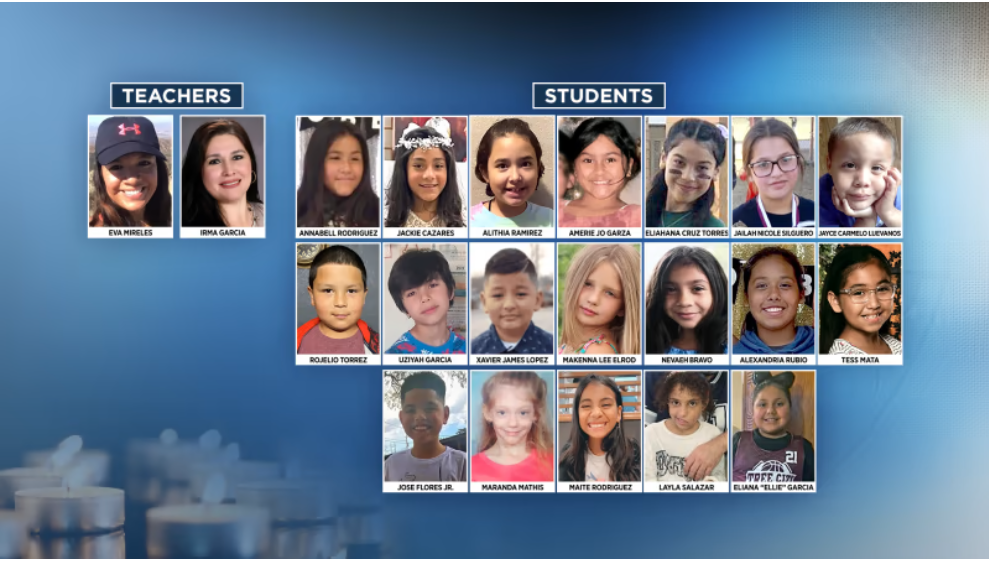
In active shooter situations, police officers are trained to confront the shooter immediately — not to wait. But in this week’s elementary school shooting in Uvalde, Texas, the gunman spent more than an hour inside the school before a tactical unit killed him, despite officers’ earlier arrival. That has raised questions about the police response — and whether some of the 19 children and two teachers who died might have been saved if officers had taken a different approach. “When there’s an active shooter, the rules change,” Texas Department of Public Safety Director Steve McCraw told journalists on Friday, as he gave the most complete account yet of the tragedy that unfolded at Robb Elementary.
McCraw identified a crucial flaw in the police strategy: The incident commander on the scene believed the situation had moved from being an active shooter scenario to one where the gunman had barricaded himself inside the school, McCraw said, with “no kids at risk,” because any civilians inside were already dead. That left a mass of officers waiting for tactical gear and keys to unlock a door, while at least two students inside frantically called 911 to plead for help. “From the benefit of hindsight, where I’m sitting now, of course it was not the right decision,” McCraw said. “It was the wrong decision, period. There’s no excuse for that.”
“Those kids need help” immediately, an expert says There are few national standards when it comes to policing, but there is some consistency. In the years since the Columbine school shooting, law enforcement officers have been trained to engage an active shooter as soon as possible.
“The protocol is, as soon as you determine there is an active shooter you don’t wait for anyone,” says Steve Ijames, an expert who has led training sessions on active-shooter situations for police agencies since the mid-1990s.
“You enter and move [to] neutralize and it may be at your peril,” Ijames said. “It’d be great if you had some help — but I can assure you those kids need help more than you need help.”
After the gunman shot at police officers in Uvalde, they called for resources like body armor and marksmen, assuming he was barricading himself inside. But McCraw said on Friday that if police believed people were still alive in the school, they would have been obligated to show greater urgency. There were “19 officers in there,” he said, adding, “there’s plenty of officers to do whatever needed to be done.”
A good example of a small town department response plan;
It is critical that every department trains for and develops a response to this type of incident because the first responding officers MUST engage the typically well armed shooter.
Responding officers must recognize that more than half of mass-shooting incidents—
57 percent—still will be underway,
75 percent requiring law enforcement personnel to confront the perpetrator before the threat ends.
And, one-third of those officers will be shot as they engage.
First responders face the threat of force as part of their daily jobs. Although tactical teams, such as SWAT, train for barricade situations and multiple-member entries, active-shooter training focuses on five-person-or-less building entries. Responding officers may not previously have trained to face this unique type of threat. According to SC Combs, “We’ve been asked to do our part to help law enforcement better prepare for the next Newtown. With so many officers engaged in shootings, it’s important we do whatever we can to help try to change that and make them safer.”
Active-Shooter Statistics
Active-shooter incidents often occur in small- and medium-sized communities where police departments are limited by budget constraints and small workforces.10
The average active-shooter incident lasts 12 minutes. Thirty-seven percent last less than 5 minutes.11
Overwhelmingly, the offender is a single shooter (98 percent), primarily male (97 percent). In 40 percent of the instances, they kill themselves.12
Two percent of the shooters bring IEDs as an additional weapon.13
In 10 percent of the cases, the shooter stops and walks away. In 20 percent of the cases, the shooter goes mobile, moving to another location.14
Forty-three percent of the time, the crime is over before police arrive. In 57 percent of the shootings, an officer arrives while the shooting is still underway.15
The shooter often stops as soon as he hears or sees law enforcement, sometimes turning his anger or aggression on law enforcement.16
Patrol officers are most likely responding alone or with a partner. When responding alone, 75 percent had to take action.17
A third of those officers who enter the incident alone are shot by the intruder.18